Legend of the Pale Lady
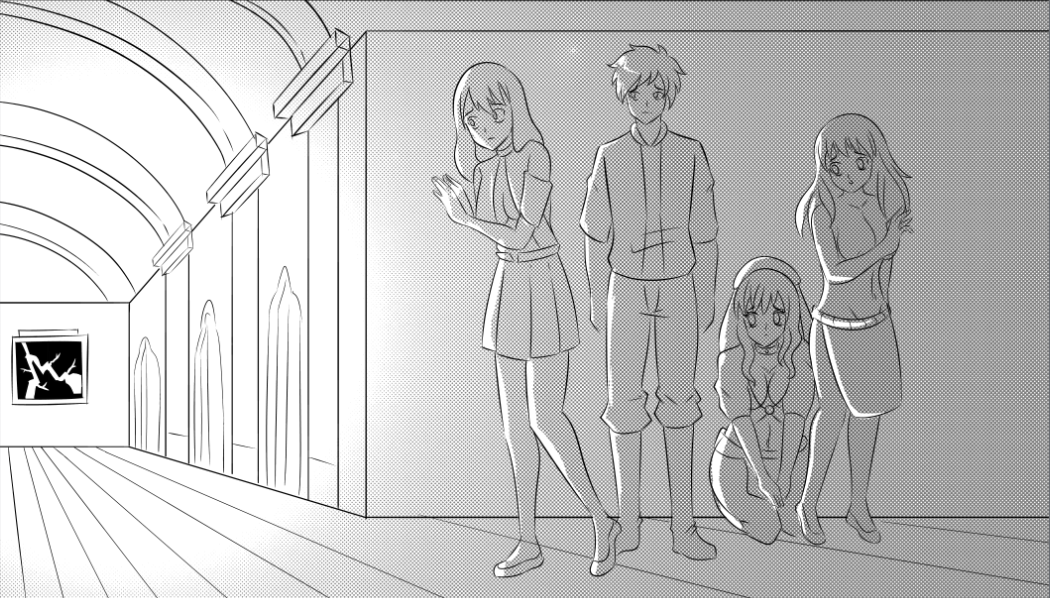
The storm outside was rough. In the months that Henry Patton had been here, there hadn’t been one like this. His mistress, Maevin Maer, had explained to him that late spring and early summer brought heavy storms, thanks to the topology of the continent he was on. The young Terran man was not a meteorologist, but he did understand that the clouds got trapped between the mountain ranges. Maevin had remarked that one did not want to be an Iron Forge Estate servant in times like this.
Right now, Henry was lying in his bed, the sheets covering only the lower half of him, trying to figure out how to get to sleep. The rain itself, clattering against the window, was not the problem. It was actually relaxing to listen to the little drums against the glass. What was the problem was the bright flash of light and the thundering boom that followed. Unlike back home, these flashes were powerful, painting his entire room white and causing him to start awake. There were curtains, of course, but they were the thin, gauzy ones for summer and thus useless at keeping the light out. The following concussive sound caused his glasses on the nightstand to dance.
“I don’t know if I’m going to get any sleep tonight,” Henry muttered to himself as he swung his legs out of bed. He stared ahead at the stone balcony, where large puddles of water danced, and in the distance, the heavy swaying of trees hidden among the gray sheets of rain. This was a bad storm.
The reluctant Lord of Blue Blossom Estate was about to consider the success of burying his head under multiple pillows when the sound reached his ears. He was actually surprised he heard it over the deafening thunder. There were voices talking in the hallway.
That is strange, Henry thought. This floor was off-limits to all but the high-ranking fourth-order maids or higher. The young man stood, grabbed his shirt, pulled it on, and made his way to the door. He could hear the voices low and trying to be quiet but failing.
“fdaisa mi anuenaeelte,” one of the female voices trembled.
Another responded indignantly.
“haema! roka ata lav shaveen kin!”
“xilvinu bav anuenae min!”
Ghost? Henry’s tired brain had not switched on the Xaltean side yet, so he was not processing the words just yet. He reached for the knob of his door.
“ke...ke ita lav ki rae??” Did you hear that?
Henry pushed the door open just as the lightning flash illuminated the faces of three very scared-looking girls. The first fell back in surprise, while the second went to shriek. The third clamped her hands over the second’s mouth quickly enough that it only sounded like a strangled yelp.
“M..m...Master,” the dark-haired one said, trembling. “We did not mean to trouble you.”
Henry blinked a few times, trying to process these women standing in the middle of the hallway in front of his door. Out of the three, there was only one that the young man recognized. That was Minda. The Inventory Maid of the 8th order was hard to forget. Her dark red hair was loose instead of its usual three braids, and her chest was the kind that made a lot of people envious. They were, of course, uncovered and right in front of him.
The other two he did not recognize.
“What is going on, Minda?” Henry asked, lowering his voice enough that the storm could cover it up.
“It is nothing, master. I am really sorry to bother you. We beg you not to tell the Mistress we snuck up here,” Minda said quickly, trying to drag the one still with her mouth covered, though her eyes had gone wide, realizing she was in front of the lord of the estate.
“We are looking for ghosts,” the one who was not silenced blurted out, then covered her own mouth. If looks could kill, Minda would have been murdering the other one right then and there.
“Ghosts?” Henry asked with a raised eyebrow. In his time here, he had not heard any stories of ghosts or anything strange happening. Though in honesty, everything that had been happening to him was strange.
“Really, it is nothing,” Minda continued, hissing at the other.
“Minda,” Henry said, adding a bit of authority to his voice. Maevin and his entourage would have thought it adorable, but for these low-ranking women, they froze, anxious eyes wide. “Can you let her go? She is going to hyperventilate.”
Minda pulled her hand back, and the girl gasped, still breathing quickly.
“Relax,” Henry tried to say, but the girl just stared at him wordlessly.
“You are embarrassing us, Enty,” Minda hissed, giving the girl a rough nudge. That seemed to finally snap the maid out of it. She straightened and gave a slightly shaken bow.
“You said something about a ghost?” Henry inquired again, his curiosity piqued. It was not like he was going to sleep anytime soon.
“We have disturbed you enough, my master,” Minda started, but the girl with the short, dark hair who had blurted out first interrupted.
“They say she wanders the halls in the worst of storms,” the woman said, eyes wide.
“Netu!” Minda said, horrified.
“Who?” Henry asked, ignoring the maid. Propriety had already gone out the window.
Netu’s voice lowered, and she leaned in closer, as if she did not want the others to hear. “The Pale Lady.”
Before Henry could ask for clarification, another burst of light filled the hallway from the window down the hall, causing every window to rattle in its frame. Henry almost screeched along with the girls.
“She is going to hear you!” Minda hissed, whacking Netu on the back of the head as Henry calmed himself down.
“The Pale Lady?” he asked.
“No! The Mistress! We are more than dead if she finds out we snuck up here.”
“Then why did you come?”
Minda glared at the two other girls, who were more than likely her juniors. “Because they swore they could find the ghost and the treasure, and I could not let them just run around without supervision.”
“And so you thought joining them was the way to go?”
Minda did not have an answer for that. She just huffed, more in irritation at herself than anything.
“Well, it sounds like you three need to get back to your floor,” Henry said with a gentle smile, hoping it made clear he was not going to report them. Minda seemed to get it as she grabbed the others by their arms to pull them away from his door.
“What about the treasure?” the hyperventilating one said with a whine. “I wanted to find the treasure!”
“Enty! Shut up!” Minda growled. “We are in enough trouble.”
“Treasure?” Henry asked. If his curiosity had not been piqued before, it was now.
The other girl, whom he assumed was Netu, nodded vigorously, her wide eyes watching him.
“Legends say that the Pale Lady is guarding a vast treasure that she is guarding for her master. We wanted to find the treasure!”
Henry pulled his door closed gently as the rain pounded on the roof of the estate, his grin growing bigger. He was not going to bed anytime soon, so why not? “Tell me more.”
Minda released Enty’s arm with a resigned sigh and walked over until they were huddled against the shadow of his door, cast by the disrupted moonlight coming through the windows that lined the hall.
“So, the stories that I have been able to find since I am the researcher,” Netu began, her hair bobbing as she spoke with excitement.
“Is that a thousand years ago, Mistress Akina Avernell was the secret lover, a…” Netu looked around quickly and lowered her voice conspiratorially. “…she was a vtedeega.”
The three looked at him expectantly, but all Henry could do was look back in confusion.
“I do not know what that is.”
“A vtedeega is someone who is secretly having a relationship with someone they are forbidden to, either by law or by morality.”
“Relationship?”
Henry immediately understood when Netu giggled and gave a few hip thrusts as an answer.
“Oh.”
“There are some relationships that are strictly forbidden outside of the norm,” Minda clarified. “A mistress or administrator may not have a relationship with their supervisor outside of a transactional expectation.”
Henry grimaced. The young man knew he was going to regret asking this question. “Transactional?”
Minda thought for a few moments and then nodded. “You know how Mistress Maer is available to you in case you are interested in what is the human phrase I just learned.”
“Banging!” Enty threw in quickly to be helpful.
“That is it. Banging. You can bang the Mistress all you want, but she is not allowed to bear you children nor raise children you sired with anyone else. The Mistress is to remain outside of the family unit. In this case, it is said that Mistress Akina secretly bore two children for Duke of the Red Mikin Avernell because his wife was barren, even with the technology of the time.”
“I see.”
“So the story goes,” Enty continued excitedly, “that the Mistress and Duke Mikin were caught by their High Baron. It is said that Mistress Akina took her own life instead of being stripped of her bond and clothes, then given to the High Baron’s troops. In his grief, Duke Mikin hid a quantity of treasure somewhere on the Blue Blossom Estate for his children when they came of age, before he boarded High Baron Nakeet Avernell’s personal ship and tried to assassinate him.”
“Damn. And why were his children not given the treasure?”
“Both died of a disease before they reached their tenth year, and the secret of where the treasure was lost with them.”
“That is what the legend is,” Minda sighed. “History, on the other hand, lists Duke Mikin as having no children, and Mistress Akina served for ten years before transferring off the estate to the homeworld.”
Both Netu and Enty pouted. “You take the fun out of the story, Colleague Minda.”
“And you take the fun out of sleep. We should be in bed, not risking getting sent to the penance pillar. We are not supposed to be on this floor without express permission of the Mistress or our Arch Maid.”
Henry could see the terror hidden in Minda’s eyes. Half of him knew he should send them back to their dorms, but the other half did not want to be alone in this storm.
“I will cover for you,” Henry said, trying to sound authoritative and in charge.
“Really?” Enty said, surprised. “How are you going to explain this to the Mistress?”
“Do I need to?” he asked. “I am the lord of this estate. Right?”
The three nodded in agreement, but he could see the doubt in their eyes. Everyone knew how much of a terror Maevin could be when she was in a rage.
“So,” Henry started as he stepped away from the door and made sure it was locked, “let us go find ourselves a ghost!”
For the amount of time Henry Patton had lived at Blue Blossom Estate, he was still surprised about how much he didn’t know about the place. There were entire portions of the south side they were walking towards down the hallway that he had no clue were there.
The three maids walked just ahead of him, their bare feet making soft slapping sounds on the wood floor as they whispered to each other. Stormlight flickered in through the tall windows, illuminating their forms in stuttering flashes.
The group followed the curve of the hallway which led to a portion of the estate that had no windows but a few doors spaced out. It did not hide the storm as Henry could still hear it hitting the roof above him. As they passed one of the doors, Henry paused.
“What is it?” Netu squeaked as the three maids came to a complete stop.
Henry stared at the door, a tingle of anxiety going up his spine. “I thought I heard something in here. What room is this?”
“That's the observatory and don't say that!” Minda said swallowing but they all were staring at the door now. Henry shook his head. “I'm not kidding. I heard a thump of some kind.”
Enty placed her ear gently against the door, her loose outfit slipping around her baring more of her figure. Henry stepped forward out of habit to keep it out of view.
“I don't hear anything.”
“Because there's nothing there,” Minda snapped, her voice barely above a whisper.
Then they all heard it. A thump of something hitting the ground.
Immediately, Henry found Enty's arms wrapped around his waist as she hugged him close screeching into his back. He could feel her entire figure pressed into his loose clothing.
“Enty!” Minda said horrified smacking at the girl to get her to back off. “Are you trying to get the altar?”
“Oh!” the girl shrieked letting go of Henry as if he was on fire. “I'm so sorry, my master!”
Henry waved her off, his heart beating fast though he was not sure if it was because of the girl or the sound they heard. The other reason could be that Netu had opened the door and gone in.
“Oh, no! The pale Lady has gotten her!” Entry shrieked again but Netu's voice came from inside amused. “No, I'm in here. Get in here!”
The observatory opened into an octagonal chamber, its walls lined with shelves heavy with books of every size and binding. Each wall section between the tall windows held another span of shelving, broken only by narrow ladders on rails that let one reach the higher tomes. How the hell did he not know this was here?
At the center, thick rugs softened the polished wood floor, and clusters of deep, velvet chairs circled a few low tables. A gentle glow bathed the room from the fireplace that crackled though Henry knew it was a heating coil with holographic flames. Its simulated flames flickered convincingly, orange light dancing against shelves and spines.
“This place is amazing!” Henry said in awe looking around.
“Seriously, you've never been in here?” Minda responded trying not to sound disbelieving.
“No. It's either my room or my office on the second floor,” Henry said with a shrug. “Never thought to go looking anywhere else.”
Henry stepped deeper into the observatory, the soft rugs muting his steps. The storm’s growl outside seemed muffled here, yet somehow heavier, like the weight of thunder was pressing down through the roof itself. The flicker of the false flames from the coil-fireplace painted the walls with restless shadows that darted across spines of ancient books.
“This place feels…” Netu trailed off, her voice too high and too fast. “Too quiet.”
Henry ran a hand along a shelf absently, his palm brushing along the fine grain. There was no dust so the place was being maintained.
The girls clustered together, but every time the storm cracked outside and the windows rattled, they jolted like startled rabbits. Henry wasn’t much better. His pulse was quick, and he swore he could hear faint breathing that wasn’t theirs.
Then Enty leaned closer to one of the tall windows, her loose gown slipping off one shoulder. She gasped softly at the lightning that illuminated the glass, but Henry caught himself staring at the bare shoulder before snapping his eyes away, annoyed with himself. Not the time.
“Did you see that?” she whispered sharply.
Henry’s mouth was dry. “What?”
“A face. In the glass.”
Netu whimpered. “Don’t say that!” She grabbed Enty’s arm, pressing herself close, and in the jittering glow Henry noticed how her short tunic pulled higher as she crouched. His nerves twisted—not just from fear, but from how aware he was of all of them. It was annoying that his heightened senses from the adrenalin also made him notice things Henry that thought he had gotten used to.
“Let’s… just look around,” Henry said, forcing his voice into something steadier. “If there’s a ghost, it’s not going to be waiting politely by the window.”
They moved toward the center of the room. The velvet chairs looked inviting, but the way their shadows pooled in strange, unnatural shapes made Henry uneasy. When the storm lit up again, he thought he saw someone seated in one, pale and long-limbed, watching. He blinked, and it was empty. His imagination was getting to him.
His stomach turned.
“Master?” Minda’s voice trembled. She was hugging herself, but her braids had loosened more, strands clinging to the sides of her face. Her thin nightshirt shifted when she folded her arms tighter, and Henry could see the outline of her against the firelight.
“I’m fine,” he lied, though his throat was tight.
Another thump echoed—closer this time, like something had fallen upstairs. Enty shrieked and stumbled against him again, her chest pressing into his arm as she clung instinctively. Henry almost cursed aloud, caught between terror and the heat of her sudden nearness.
“Don’t—don’t do that,” he hissed.
“I can’t help it!” she squeaked.
“Enty!” Minda said, pretense done. The higher ranking maid grabbed the girl by the hair and roughly pulled her away. “Know. Your. PLACE!”
Henry didn't have time to tell her to calm down as the four of them turned in unison when one of the ladders on rails creaked. Slowly, it began to roll along the shelf, though no one was near it.
Netu gasped, covering her mouth with both hands.
Henry’s skin prickled, his eyes darting from shadow to shadow. Part of him wanted to bolt out the door.
He swallowed hard. “We're letting this ghost story get to us. We need to calm down.”
There was another flash and this time a massive explosion as some tree on the estate was decimated by the lightening. The resounding crack caused all the girls to shriek and make a mad dash around looking for an escape.
It was Netu who fell against the book case, gropping wildly to keep herself from falling over. As she did, something clicked and the book case shifted as if released by some sort of lever.
The young maid stood there shivering and Henry moved over fascinated at what happened. It appeared that there were stone steps behind leading somewhere deep.
“Good job!” Henry turned to Netu but choked slightly. She stood there shivering only wearing the scared expression on her face having fallen out of her loose clothing in the mad dash to escape
Minda scooped up the girl's night gown and threw it at her. “Cover yourself!”
She's one to talk, Henry said to himself noting that Minda was still completely topless.
The stone steps sloped steeply down, the air growing colder with every step. Henry could smell damp stone, sharp with the tang of mold. It was like the walls themselves were exhaling on them. As they walked, there was a flicker and then dull illumination as slivers of glass lit up as they past. Henry's guess they were motion activated but with the struggle they were having, they probably hadn't been used in years. The layers of dirt on top gave them a sickly yellow glow.
They had entered a large, enclosed area and Henry swallowed again. There were stone crypts in neat rows down the open space.
Minda paused at one, brushing her fingertips over the dust-caked groove. “This is… old Xaltean,” she whispered, “I can’t read it all. Some of these symbols are archaic.”
Henry leaned close, though the marks seemed to writhe when the lantern light wavered. The edges blurred, then seemed to sharpen again. His pulse climbed. He swallowed hard, glancing away, but when he did he found his eyes catching on Enty’s silhouette as she leaned over a sarcophagus lid. Her thin gown was pulled tight, the curves beneath shifting as she braced herself. Henry snapped his gaze away, annoyed at his own distraction, but the flicker of heat mixed with his rising dread only made him more unsettled. Why was his senses on fire?
“Why are there so many of them?” Netu’s voice cracked, trembling as she pointed toward the rows of stone boxes. Their lids were carved with figures; faces weathered smooth, but their eyeless sockets seemed to follow.
“They’re sarcophagi,” Minda muttered. “Family crypts, most likely. Blue Blossom has been an important estate for over a thousand years. I think the history archives say it is where House Avernell began.”
The motion lights above had, for the most part, failed casting most of the area in shadow. As he looked at one of the carvings, Henry could have sworn he saw one of the carved figures lift its head. He blinked hard, and it was still stone. But the hairs on the back of his neck rose.
“I… I think something’s in here with us,” Netu whispered, her breath ragged.
“No,” Henry said, too quickly. “It’s just the storm. Just shadows.”
It had to be but his body didn't believe him. He could feel whatever it was moving about. But then a whisper coiled around his ear, low and breathy: Henry.
He spun, heart hammering. Nothing. Just the maids, wide-eyed, clinging to each other. Enty clutched at his sleeve, her whole body trembling against him, and he nearly leapt himself from the sudden contact.
“It’s close,” she whimpered.
The carved walls appeared to ripple, shapes bending in the corners of his vision. Shadows stretched too long. The sound of footsteps echoed behind them, perfectly in step with their own.
“Keep moving,” Minda urged, though her own voice shook. Her nightshirt clung to her in the damp air, translucent now against her skin. She must have been sweating something fierce.
They moved deeper. The air was heavy, almost wet, the further they went the more of the motion lights failed. Something moved at the edge of Henry’s vision—a tall, pale figure drifting just behind them. When he looked, it was gone.
Then the sound came: a low scrape, like stone dragging against stone. One of the sarcophagi shifted, just an inch.
Henry lost it.
“Run!” he shouted, not caring how childish it sounded.
The girls didn’t need telling twice. They bolted, shrieking, their bare feet slapping against the cold floor. Henry was right behind them, the weak overhead lights blinking wildly and randomly, throwing mad shadows across walls and carvings that twisted into screaming faces. The air seemed to laugh around them.
They burst through a narrow passage, their panic driving them forward, until the floor sloped up sharply. A final stone archway yawned open and they stumbled out into the storm.
Cold rain hit Henry like a wall, drenching him in seconds. He staggered forward, chest heaving, lightning flashing to reveal a vast stone dais ahead, its pedestal gleaming wet in the downpour. Trees loomed around them, and Henry realized with a jolt that they were at the far west edge of the forest.
Behind him, the maids leaned forward, using their knees for support gasping for breath. For a moment Henry thought he still saw the Pale Lady at the mouth of the passage, pale and watching—before another blinding flash erased the vision.
Henry wiped rain from his face, his heart hammering. They were outside, but the storm was no safer than the crypt.
The storm lashed down in heavy sheets, rain plastering Henry’s hair to his forehead as he tried to steady his breath. The dais loomed around them, the pedestal rising like a sentinel, and the forest beyond was alive with thunder.
Through the blur of downpour came light—lanterns and flashlights bobbing between the trees. Figures emerged, soaked but steady, their boots splashing through the mud. Maevin was at the front, her posture and stance seemingly incapable of being bent by the storm. Her hair was pulled back in a pony tail with segments of ribbon running down to keep it under control, Tox and Nish close behind, Abiva flanking with a squad of security.
“Oh, goddess,” Minda whispered, paling.
Henry’s stomach tightened. The girls were in no state to present themselves—drenched, clothing half-clinging, faces pale with fear. And Maevin’s expression, when she closed the distance, was glacial.
Her eyes swept the scene once, sharp as knives. “What,” she said, her voice icy and full of malice, “are you doing?”
All three girls froze, trembling under her gaze. Enty tried to speak, but only stammered. Netu shrank back. Even Minda, usually confident, bowed her head low.
“I have dealt with disobedient maids who do not know their place,” Maevin's voice cut through the storm, scaring even the thunder. “But this...in the middle of a summer maelstrom. This is wreckless beyond anything I have every seen.”
The trio shrank even more now scared of their mistress than the gale.
Henry swallowed, ready to say something to ease the weight, but Maevin turned to him—and her eyes softened, just enough. “My lord,” she said with a small bow of her head, “I regret that your evening was disturbed by such disobedience.”
Henry shook his head quickly. “No, I…” He glanced at the maids, shivering and silent. “It wasn’t entirely their fault. There was a passage behind the bookcase. We thought it worth investigating. I take full responsibility.”
“Do you?”
He could see the slightest of upturned chin. Henry had been here long enough to know what that meant. He knew that the maids had crossed a line even with his own behavior and right now, if he stopped the Mistress, he would make her look weak. This was her estate to run and the Xaltean woman expected supreme obedience of her maids.
“I chose to go in that strange crypt place and they accompanied me. Everything from that point is my fault.”
Henry opened his mouth to take the entire blame as he promised but Enty was the one who stepped forward. She stood tall as the young maid stepped forward and then immediately bowed in front of her mistress, ignoring the rain beating her senseless.
“The master is kind and covers for the disobedience of his maids,” Enty stared and Netu made a strangled sound in the back. “We were out of our rooms searching for the Pale Lady and snuck to the third floor. Colleague Minda tried to stop us but we disobeyed. She came along to try and keep us from causing more trouble.”
At that, Maevin's eyes grew even darker. “You entered the third floor...without permission.”
Enty nodded her head, eyes still faced down.
The young terran knew he couldn't get into any trouble but he could fear the palpable fear of the trio around him.
“And what do you two have to say for yourselves?” Maevin asked, those icy eyes locking on the other two. They stepped forward and also bowed their heads. “No excuses, Mistress.”
Mistress Maevin Maer turned to look at her master, her eyes cooly watching his face.
“Does my master wish anything?”
Henry looked at the trio. He nodded. “Maevin, I only ask that you absolve them of the ghost hunting and the crypt after they came to the third floor. I promised that I would take the blame for that.”
She nodded but he could see the irritation in her eyes. Maybe it was the weather or the fact it was in the middle of the night so she didn't hide it that well.
“But the initial infraction,” he continued. “I will leave to you to discipline as needed.”
Her eyes cut back to the three maids, who waited for their fates. “I understand that you three are new to life as a servant to this house and there are many things I could forgive as exuberance but violating the safety and security of the master's floor is one that I cannot let go lightly.”
“Yes, Mistress,” they chorused weakly, heads low.
“Netu and Enty, you will be placed on the pillar immediately for your transgressions and a negative mark to your records. At the height of the shift, you will also be switched in front of your colleagues as an example of what happens when you break the rules.”
The young Terran saw their faces pale even in the light. He knew what that meant. They would be stripped, have their hands tied above their heads at the marble pillar on the south side of the estate and left on display for the day to the elements. Siv had explained enough about nudity is a personal choice and having that choice removed was extremely embarressing and humiliating. Not to mention getting switched with a flexible rod against the back of their legs. Punishment here was designed to humiliate more than anything.
“Maid Minda. You also violated a most explicit rule even if it was a ill conceived attempt at stopping your juniors.”
“Yes, Mistress.”
“I will not be giving you a black mark but your choice is either take a reduction from 8th to 9th order and return to the fields as a Harvestor or you may join these maids on the pillar and share their punishment.”
Minda did not hesitate. “I am responsible for my juniors. I will share the punishment with them.”
Maevin did not say anything more, she roughly waved them off with her hand.
Abiva and Nish moved in fast, their fury not hidden on their face.
“Move!” Abiva snarled as Nish demanded they remove their clothes immediately. They would be marched back to the house with nothing on, their punishment beginning immediately.
“Maevin—”
“You need not explain yourself further,” she said softly. “This is your house. I will not tell you where you may or may not go.” A pause, her gaze tightening just a fraction. “But these girls are not you. And they will not be permitted such liberties again. I cannot.”
“They were just curious.”
Maevin stepped forward, her body cutting the rain as she spoke low so the security presence couldn't hear.
“My master. You still do not comprehend how important and how dangerous life among the house can be. It just takes one spy or treacherous maid to end your life.”
Of course. Maybe it was just a part of him that didn't want to accept that somebody would want to hurt him.
“Understood.”
Maevin stepped back but he gently reached out to stop her.
“I'm sorry, Maevin. I mean it.”
There was a softness in her eyes he had never seen before but in a flash it was gone and the Mistress of his estate was back.
“Let us return to the house before the full brunt of the storm arrives.”
The doors of the Blue Blossom Estate swung closed behind them, shutting out the howling wind and the relentless downpour. Water dripped from the girls’ hair as they had been brought in before him. The water formed little puddles on the polished stone floor. They were still naked but the two Arch Maids were pouring glasses of a strong smelling liquor that he could smell from where he was standing.
“Aeska,” Maevin explained. “It helps the constitution of those who drink it especially when one is about to be subjected to stress.”
“The storm?”
“I will order the energy shields activated in that area. It will protect them from lightening and any projectiles picked up by the wind but they will still face the cold and wind. It's the least they can do after breaking the rules.”
Henry followed, his boots splashing lightly, as the girls were herded back out the door. His mind still racing from the descent into the crypt.
Once out of the grand foyer and into the estate proper, the warmth of the estate beginning to chase the chill from their bones, Henry finally found a moment to breathe and to ask the questions that had been gnawing at him.
“Maevin… about the crypt,” he began carefully, “and… what we saw down there. The… things we thought we were seeing… hallucinations?”
Maevin’s expression softened briefly, though the edge in her posture remained. “Ah,” she said, “you are referring to the effects of the pollen.”
Henry blinked. “Pollen?”
“Yes,” Maevin continued, brushing a damp strand of hair from her face. Another maid appeared with dry towels. She led Henry to a room to the side where he recognized the entryway of the rain rooms. When alone, Maevin stripped off everything and began to dry her hair.
“There are spores in the lower portions of the estate—harmless in themselves, but known to induce strong hallucinations. They cling to the air in enclosed, damp spaces. That is why the crypt appears… more lively, more frightening, than it is in reality.”
“So… the sarcophagi, the shadows, the… figures?” Henry asked, turning his back and trying to peel his own clothes off. If Maevin was comfortable, he was going to try and be. “All of that was just the pollen messing with our heads?”
Maevin inclined her head slightly. “Exactly. Harmless, but potent in its effect on perception. It is known to stir fear and exaggerate imagination, especially among the young and unprepared. It is also why the crypt has not been cleaned or disturbed. There is nothing of real interest there, and yet it remains preserved. No one risks going in unless it is necessary, for fear of accidents.”
Henry let out a low whistle. “So… it’s just a family crypt. It’s not off-limits, then?”
“Not truly,” Maevin replied, pulling a clean, gauzy nightgown over her head and shoulders and shimmying it down around her knees. She faced away letting him finish getting dressed. “It is simply… unremarkable. A repository for ancestors, nothing more. Yet its location and history lend themselves to the stories your maids were so eager to chase.”
“I see. I suppose that explains the… intensity of what we experienced.”
With his dry clothes on and the exhaustion finally catching up, the two stepped out again and made their way towards the stairs.
Maevin folded her hands in front of her and the quiet, proper lady appeared.
“Does the master wish anything before bed?”
The dark haired woman stood there as if the entire fiasco hadn't happened. How he envied how calm she was.
“No. I'm good. Thanks.”
With that, Maevin turned and walked off leaving him alone. Henry let out a long, shaky breath, finally feeling some of the tension drain from his shoulders. Just as he relaxed deciding to make his way to his room, a faint whisper drifted from somewhere deep in the estate—a soft, almost playful sigh that made the hairs on his neck stand on end.
Henry froze. Then blinked.
“You know… I’m gonna sleep in the lounge tonight.” he said and quickly made his way to the brightest room in the house.
